

Innovation has never been a perfect journey
Every rocket launch carries more than satellites or scientific equipment into space. It carries years of engineering, billions in investment, national ambition, and the hopes of thousands of people working quietly behind the scenes.
And when a launch fails, the reaction from society often says more about us than about the technology itself.
The global space economy is projected to cross one trillion dollars over the coming decades. Private investment has transformed the sector from a government-driven domain into a rapidly expanding ecosystem involving startups, venture capital firms, universities, defence players, telecommunications companies, and emerging economies.
But behind the excitement lies an uncomfortable reality. Space is expensive. Space is uncertain. Space is unforgiving.
A single orbital launch can cost anywhere between fifty million and five hundred million dollars, depending on the mission profile, launch vehicle, and payload. Developing a new launch system can take years of testing and billions in funding before commercial viability is achieved. Even smaller startups building propulsion systems, satellite applications, robotics, or earth observation technologies depend heavily on patient capital and long-term investor confidence.
This is why every major setback creates waves far beyond the launchpad. Markets react emotionally. Investors grow cautious. Governments begin asking difficult questions. Public conversations shift from excitement to doubt almost overnight.
Who Is Allowed to Fail?
Not all failures are viewed equally.
When established companies, large corporations, or technologically advanced nations face setbacks, the public conversation often remains optimistic. Analysts speak about experimentation, resilience, and learning curves. Investors continue backing future missions. Society assumes eventual success. The failure becomes part of the story.
But when smaller startups, first-generation entrepreneurs, or developing nations encounter similar setbacks, the reaction can be noticeably harsher. Questions arise about capability, credibility, and whether they should have attempted such ambitious projects in the first place. It is almost as if some actors are socially authorised to fail while others are expected to succeed immediately.
This unequal perception quietly shapes innovation ecosystems around the world. But there is something more corrosive buried within it. A habit of watching who is attempting something rather than what is being attempted and why it matters.
When a setback becomes a conversation about the identity, nationality, or resources of the people behind it primarily, the technology itself disappears from the discussion. Progress gets buried under personalities. The space sector cannot afford that distraction.
The physics of orbital mechanics does not care which flag is painted on the rocket. A breakthrough in propulsion, materials science, or autonomous navigation benefits the entire ecosystem regardless of where it originates. The most consequential advances in space technology have rarely come from any single nation or company working in isolation. They came from accumulated knowledge across generations, institutions, and borders.
There is a real risk, particularly in the current geopolitical climate, that the wrong lessons get drawn from moments of failure. The instinct to retreat and conclude that critical capabilities must be developed entirely domestically, that partnerships carry too much exposure, is understandable. But it is also slow, expensive, and increasingly at odds with the scale of what the space sector is now attempting.
Redundancy and resilience are not the same as isolation. A sector that fragments entirely along national or commercial lines, where every player insists on reinventing every component independently, does not become stronger. It becomes slower and more brittle at the precise moment when speed and shared capability matter most.
The more productive response to any failure, whoever experiences it, is to ask what the technology revealed and how the broader ecosystem can move forward more intelligently as a result. That shift, from watching who stumbled to understanding what was learned, is what separates industries that genuinely progress from those that simply compete.
When a Test Does Its Job
There is a distinction worth making that rarely surfaces in popular coverage of industry setbacks.
Not all failures are the same kind of failure.
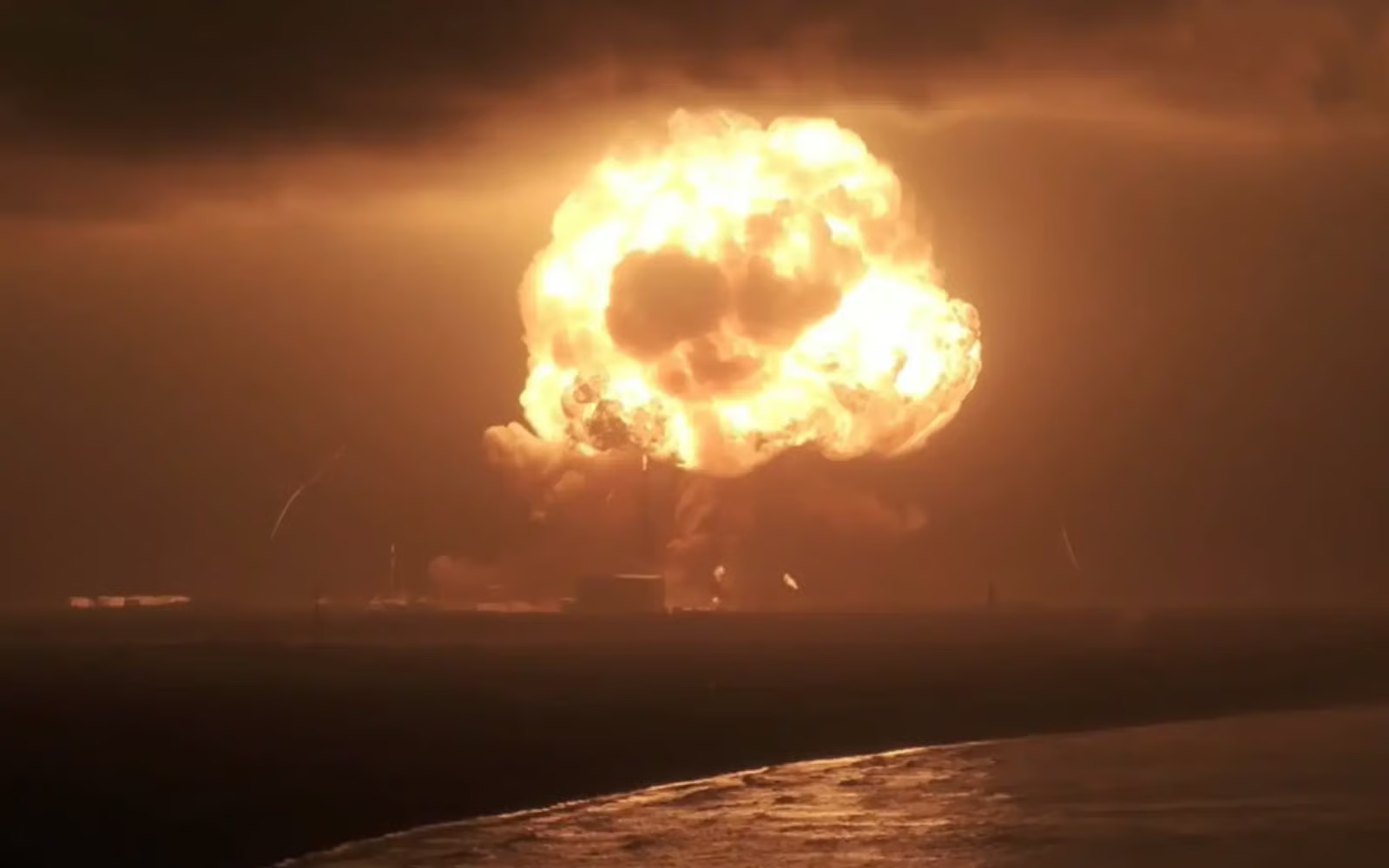
A rocket that encounters a critical anomaly during a ground fire test is, in a specific and important sense, doing exactly what the engineering process is designed for. Ground testing exists to surface problems before they endanger missions, payloads, and eventually crew. The violence of the event, the fireball, the structural damage, the shockwave felt kilometres away, does not change the underlying logic. The system revealed its flaw on the ground. That is the process working.
This is not a rationalisation. The consequences are real. A destroyed launchpad, a grounded vehicle, months of investigation, cascading delays across partner programmes. These are serious setbacks with long ripple effects. But the public conversation rarely makes this distinction. What a camera captures is fire and smoke. What it cannot capture is the decade of engineering behind the vehicle, the safety protocols that ensured no one was hurt, and the frank response of a team that said it would rebuild whatever needed rebuilding and get back to flying.
That response deserves more attention than the fireball.
The Hidden Cost of Concentrated Dependency
The deeper lesson these moments surface is one the industry has been circling for some time.
When any significant vehicle or programme fails, the ripple effects no longer stay contained. They travel into government programmes, outward into commercial supply chains, and into the strategic ambitions of nations that have staked long-term plans on particular launch architectures or provider relationships.
Concentrating critical capability in a small number of vehicles and launchpads creates a structural fragility that individual failures can suddenly expose. When one heavy lift vehicle is grounded, the programmes depending on it face a harder question than simply waiting. They face the question of whether credible alternatives exist, how long those paths would take, and what strategic compromises they would require.
This is not an argument against ambition. It is an argument for building ecosystems rather than dependencies, for investing in multiple launch providers, multiple vehicle architectures, and genuine industrial diversity that makes any single failure recoverable rather than catastrophic.
The space sector needs more competition and more distributed capability. Not because failure is inevitable, though it is, but because a resilient industry is one where failure in one node does not threaten the entire network.
The Fear of a Bubble
There is increasing discussion around whether parts of the commercial space sector are entering a speculative bubble. Concerns about inflated valuations, unrealistic projections, and overdependence on venture capital are not entirely misplaced.
Over the past decade, billions of dollars flowed into space startups globally. Governments introduced incentives and strategic investments as space increasingly intersected with telecommunications, defence, climate monitoring, navigation, agriculture, logistics, and national security. At the same time, the barriers to entry started to decrease. Smaller satellites, reusable launch technologies, and growing private participation created genuine opportunities for startups and emerging economies to participate.
But this transformation also creates pressure. When high-profile failures occur, investors risk questioning the entire industry rather than evaluating individual companies on their merits. Funding slows. Risk appetite declines. Long-term projects become difficult to sustain. Eventually innovation slows, not because the ideas ran out, but because the patience did.
The more important question is whether the sector can afford to stop experimenting at all. Climate monitoring, global navigation, weather forecasting, precision agriculture, disaster response, and border security are all deeply reliant on space-based infrastructure. Geopolitical competition in space is intensifying. Nations have come to understand that future strategic and economic influence will partly depend on what they can do beyond Earth.
In that environment, the cost of caution may be higher than the cost of failure.
The Emotional Weight of Deep Technology
What often goes unnoticed is the sustained pressure carried by founders, engineers, scientists, and investors working in deep technology sectors.
Unlike software ventures that can pivot relatively quickly, space companies operate in environments where a single technical failure can erase years of work overnight. Public scrutiny is relentless because failures are visible, expensive, and impossible to contain. And yet the people behind these moments are rarely given room to process what has happened before the commentary cycle has already moved on.
Public opinion is increasingly shaped by fast reactions and algorithm-driven commentary that rewards certainty and outrage over patience and nuance. Complex technical events get reduced to simple narratives. Organisations get defined by their worst moments rather than the arc of their progress.
Over time, this creates a quiet but significant cost. If founders and engineers internalise the message that one public setback defines their credibility, fewer people will attempt genuinely difficult problems. Innovation ecosystems become more conservative not through any formal policy, but through accumulated cultural signals about what kinds of ambition are acceptable.
Progress Was Never Linear
Human history has not advanced through perfect execution. Electricity, aviation, medicine, computing, and space exploration all emerged through experimentation, setbacks, and persistence. Many of the ideas that eventually became foundational were dismissed or ridiculed before they became real.
None of this means every idea deserves uncritical support. Investors must ask hard questions. Governments must ensure accountability. Companies must operate responsibly and communicate honestly when things go wrong.
But there is a clear difference between rigorous scrutiny and reflexive cynicism. One builds better systems. The other builds nothing.
A mature innovation ecosystem understands that experimentation carries costs, and that refusing to experiment may carry greater ones. The space sector does not need protection from criticism. It needs the kind of thinking that is capable of holding two things at once: honest assessment of what went wrong, and genuine belief in the value of continuing.
The real question before the industry is not whether failure should exist. It is whether the ecosystem around it, the investors, the media, the governments, and the public, is mature enough to absorb failure, extract its lessons, and keep moving forward.
That capacity, more than any single rocket or mission, will determine what the space sector is able to become.
Spacepreneur Magazine is a growing platform connecting founders, startups, investors, engineers, researchers, policymakers, and enthusiasts across the global space ecosystem. We invite stakeholders from across the industry to subscribe, engage, and share their stories, lessons, and insights, because the future of space will not be shaped by technology alone, but by the people courageous enough to build it.
