

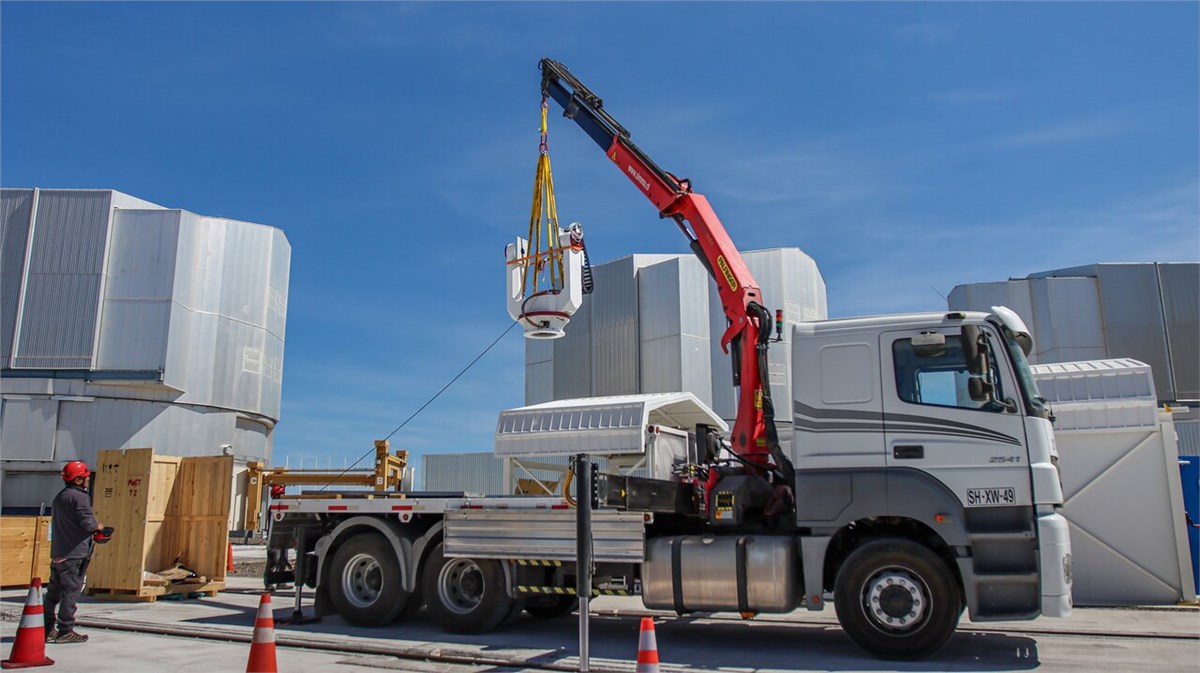
The Paranal solar ESPRESSO Telescope (PoET), installed at the European Southern Observatory’s (ESO’s) Paranal site in Chile, has made its first observations. The telescope will work with ESO’s ESPRESSO instrument to study the Sun in detail. Described as a solar telescope for planet hunters, PoET aims to understand how variations in the light from stars like the Sun can mask the presence of planets orbiting them, helping in the search for worlds outside the Solar System.
“One of the greatest challenges for the detection of other Earths orbiting other Suns is the astrophysical ‘noise’ coming from the host stars,” explains Nuno Santos, the Principal Investigator for PoET, based at the Institute of Astrophysics and Space Sciences and the Faculty of Sciences of the University of Porto, Portugal. “PoET observations could be key to the discovery and characterisation of exoplanets which may currently be hidden in the noise.”
Exoplanets — worlds outside our Solar System — are mostly detected and studied by looking at the light from their host star, often by examining small changes in the star’s spectrum. But stellar activity can produce signals that drown out, or even mimic, those expected from an orbiting planet. Much like sunspots alter sunlight, surface activity on other stars distorts their spectrum in a way that can be measured as ‘noise’ with current exoplanet-hunting instrumentation. However, removing this noise from the spectra of distant stars is challenging because we do not fully understand how stellar activity changes the light we observe. The solution is to learn from our nearest star, the Sun.
PoET’s design makes it uniquely capable of using the Sun to understand the spectra of distant stars. It features a telescope with a mirror 60 centimeters in diameter that gathers light from specific areas of the Sun, such as individual sunspots, probing the signatures of stellar activity. PoET also includes a smaller telescope that collects light from the entire visible surface of the Sun, known as the solar disc.
“We will be able to analyse very specific areas of the Sun with very high resolution in a way never done before,” says Alexandre Cabral, PoET co-Principal Investigator and a researcher at IA and the Faculty of Sciences of the University of Lisbon, Portugal. By observing simultaneously both the solar disc and individual surface features, astronomers can determine exactly how stellar activity changes the solar spectrum. This can then be used as a guide to precisely remove ‘noise’ from distant stars that may be harboring exoplanets.
To ensure the Sun can be compared to distant solar-type stars, the team needed a precise instrument designed for exoplanet research. “ESPRESSO is the top instrument in the field, so the choice was obvious,” says Santos. Because ESPRESSO is an extremely precise, high-resolution spectrograph, it is capable of detecting tiny changes in the spectra of stars, typically to find or characterize planets orbiting them. An exoplanet instrument on ESO’s Very Large Telescope targeting distant stars by night, ESPRESSO will now also be used with PoET during the day to analyze solar spectra.
“It is a great advantage to have ESPRESSO working in this way. By switching from the VLT at night to PoET during the day, we maximize the usage of this instrument to help us find and characterize exoplanets,” says ESO’s Alain Smette, VLT Operations Staff Astronomer and ESO contact person for PoET. “Thanks to the exceptional location of the Paranal Observatory, the number of available days when weather conditions are suitable for observations of the Sun is expected to be very similar to that for nighttime observations.”
