

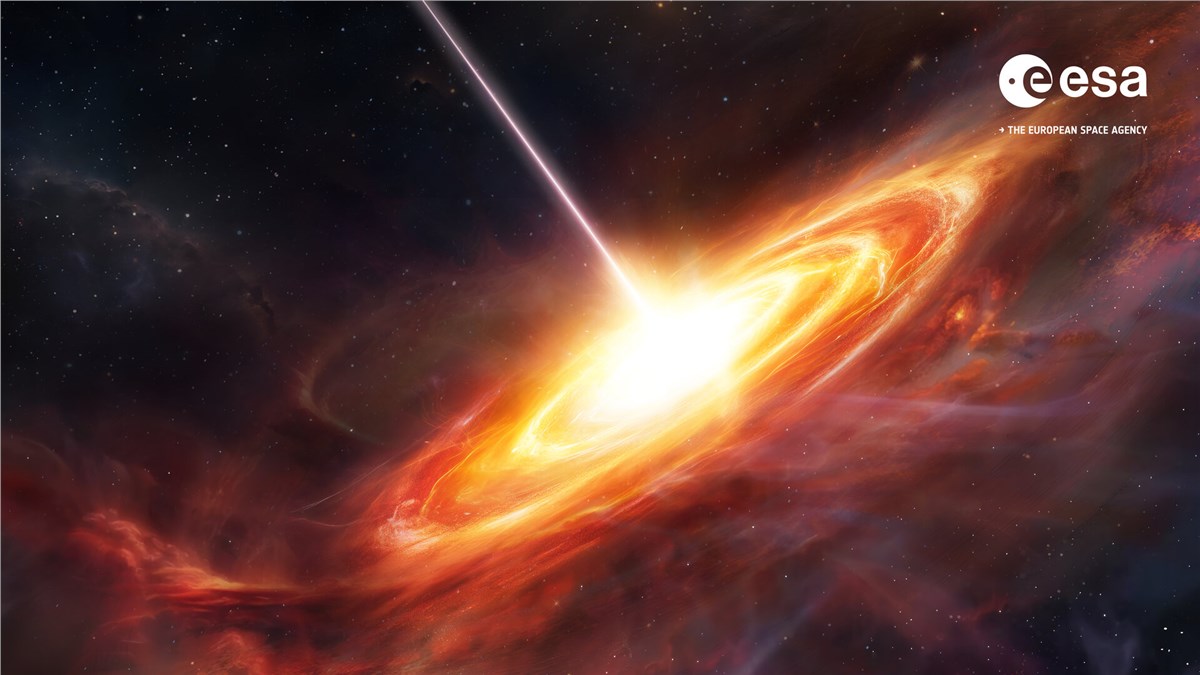
The European Space Agency’s Euclid space telescope has discovered 31 of the most ancient quasars ever found. Two of these giant and dazzling galaxy cores, powered by gargantuan black holes, are the earliest quasars yet observed in cosmic history. They shone with the light of a trillion Suns back when the Universe was 670 million years old — just 5 percent of its current age.
Quasars represent a brief phase in a galaxy’s life during which large amounts of material spiral into the central supermassive black hole, releasing enormous amounts of energy. In this phase, the galaxy’s nucleus shines more brightly than anything else in the Universe, often outshining the rest of its host galaxy by hundreds to thousands of times.
Astronomers have been hunting for the Universe’s very first quasars for decades. These objects reveal what was happening during the earliest days of the cosmos, including how the first supermassive black holes and galaxies took shape. However, quasars from this time are difficult to find. They are rare, and their primordial light is both faint and easy to confuse with that from stars lying closer to us.
Euclid, launched in 2023, is digging deeper into this ancient cosmic history with exciting results. The telescope has now discovered an unprecedented number of 31 new quasars in the early Universe, pushing back to a time when the cosmos was just 5 percent of its current age.
Daming Yang of Leiden University, lead author of the discovery paper, stated:
“These early quasars date back to the Universe’s infancy. By finding and studying them, we can better understand how these enormous systems formed and grew so quickly — one of the greatest mysteries in astrophysics.”
Beneath the Tip of the Iceberg
The earliest quasars known until now were just the tip of the iceberg: the rare and bright outliers that have been easiest to spot. Euclid’s new finding captures not just the bright outliers but most of the ancient quasar population. The discovery adds 12 new quasars at a redshift of 7 or above, corresponding to the first 770 million years of the Universe.
The two most ancient of the batch, EUCL J172902.75+641018.1 and EUCL J125308.55+705432.3, have redshifts of 7.77 and 7.69, respectively, setting a new record for the most ancient quasars ever found. Both lie just over 13 billion light-years away and emerged during the Universe’s first 670 million years.
Antonio La Marca, ESA Research Fellow in the Euclid team, added:
“This finding more than doubles the number of quasars we know of that are so ancient. Discovering the first 10 or so quasars at a redshift of 7 or above took astronomers more than a decade — but Euclid has already discovered more than that in a single year.”
The quasars hark back to a fascinating period in cosmic history known as the epoch of reionisation, when everything shifted from being cold and dark to hot and ionised by energetic light. This transitional epoch set the stage for everything we see today.
Valeria Pettorino, ESA Euclid Project Scientist, concluded:
“Ancient quasars are rare discoveries. They’re interesting in themselves, but also time machines that enable us to explore the early Universe and understand how the first generation of galaxies came to be. Euclid’s capabilities are unrivalled. The telescope combines a large area, depth, sharp imaging, and unique space-based infrared vision in a way that lets us pick out rare, extremely distant objects far more efficiently than before.”
