

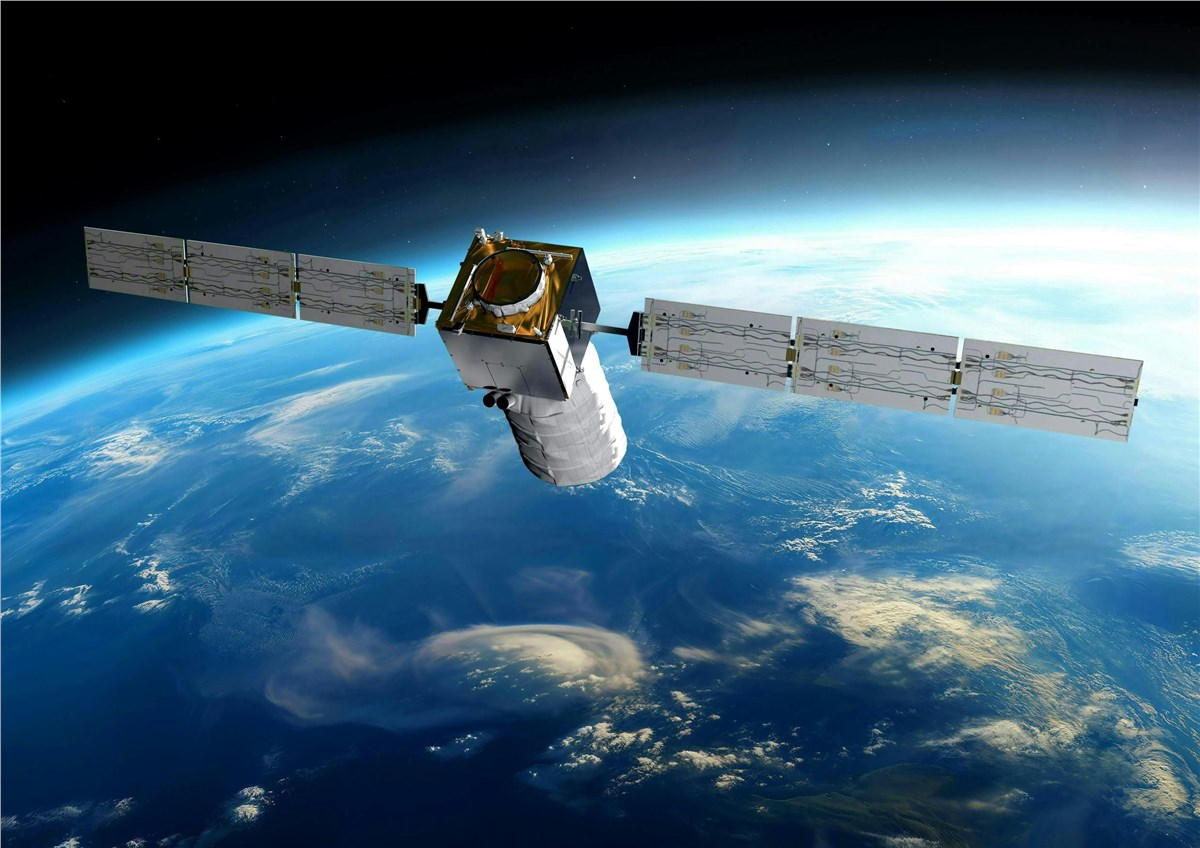
Airbus Defence and Space has signed the initial contract for the design and build of the Aeolus-2 wind sensing satellite from the European Space Agency (ESA) at a ceremony at ESA’s UK headquarters ECSAT at Harwell.
Aeolus-2 will follow the first Aeolus wind sensing satellite, built by Airbus and launched in 2018. The first satellite provided the first-ever high-resolution vertical wind profiles from space, enabling a 4 percent improvement in numerical weather forecasting and significantly enhancing the accuracy of global weather prediction models.
Simonetta Cheli, ESA’s Director of Earth Observation Programmes, stated:
“Aeolus exceeded expectations and demonstrated the transformative impact that space-based wind observations can have on weather forecasting. Aeolus-2 represents the natural evolution of that achievement – from pioneering research to an operational service that will benefit citizens and businesses worldwide. We are happy to provide the authorisation to proceed, which marks an important milestone in ensuring Europe remains at the forefront of atmospheric observation and meteorological innovation.”
Liz Lloyd, UK Space Minister, added:
“The UK has been at the forefront of satellite weather forecasting since the original Aeolus mission, and I am delighted that Airbus Defence and Space in the UK will once again play a leading role in this next chapter. Aeolus-2 will deliver real benefits for people across the UK, from more accurate weather forecasts that protect lives and communities, to the highly skilled jobs that come from being a key partner in Europe’s most ambitious space science programmes. Our involvement in Aeolus-2 is made possible by the UK’s continued investment in the European Space Agency and EUMETSAT, ensuring British expertise and industry remain central to cutting-edge space science.”
Kata Escott, Managing Director of Airbus Defence and Space in the UK, concluded:
“Aeolus-2 is more than a scientific mission; it is a major investment in British talent. This project allows our highly skilled UK teams to apply their unique expertise to enhance weather monitoring and lead the way globally in Earth observation and science.”
Data from the first Aeolus, which flew in orbit until 2023, significantly enhanced the accuracy of global weather prediction models and provided critical data for understanding atmospheric circulation and long-term climate change. Aeolus-2 will be equipped with another pioneering Doppler wind lidar with ultraviolet lasers, scanning from the ground up to 30 kilometres, taking measurements every 0.01 seconds, and covering the entire globe every seven days. Aeolus-2 will also have an additional detector to measure aerosols in the atmosphere.
Aeolus-2 is being developed by ESA in partnership with EUMETSAT (European Organisation for the Exploitation of Meteorological Satellites) and will benefit major weather centres, including the UK’s Met Office and the European Centre for Medium-Range Weather Forecasts (ECMWF). The satellite will orbit Earth 15 times a day, deliver data to users within 120 minutes of measurement, and have a lifetime of 5.5 years.
