

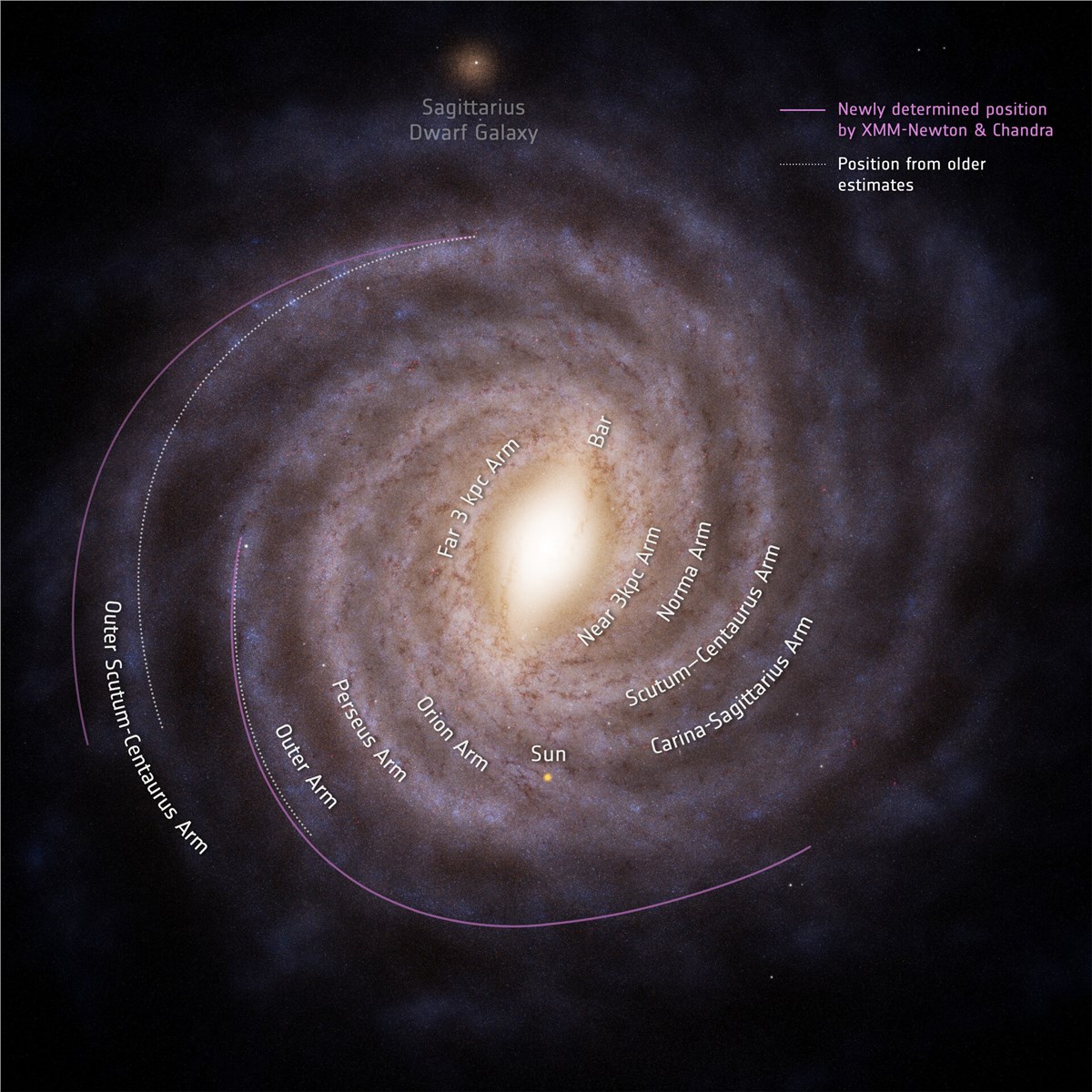
ESA’s XMM-Newton X-ray observatory has helped astronomers revise the distance to the outer spiral arms of our Milky Way galaxy, providing new insights into the structure of our cosmic neighbourhood. The study, which used X-ray data from the observatory, has allowed scientists to more accurately map the galaxy’s outer regions and better understand its formation and evolution.
By observing X-ray binaries — systems where a compact object like a neutron star or black hole pulls material from a companion star — astronomers were able to determine distances to these objects with greater precision. The data revealed that the outer spiral arms of the Milky Way are located farther away than previously estimated, challenging existing models of the galaxy’s structure.
The revised distance measurements are significant because they help refine our understanding of the galaxy’s size, mass distribution, and the dynamics of its rotation. This, in turn, improves our knowledge of how galaxies like the Milky Way form and change over time. The findings also have implications for the study of dark matter, as the distribution of matter in the outer regions of the galaxy influences how much unseen mass is present.
XMM-Newton, which has been operating since 1999, continues to provide crucial data for a wide range of astronomical investigations. Its ability to observe X-ray sources across the sky makes it an invaluable tool for studying high-energy phenomena in the universe.
The revised distances to the Milky Way’s outer spiral arms represent another contribution to the ongoing effort to map our galaxy with increasing accuracy, highlighting the importance of long-running space observatories in advancing our understanding of the cosmos.
